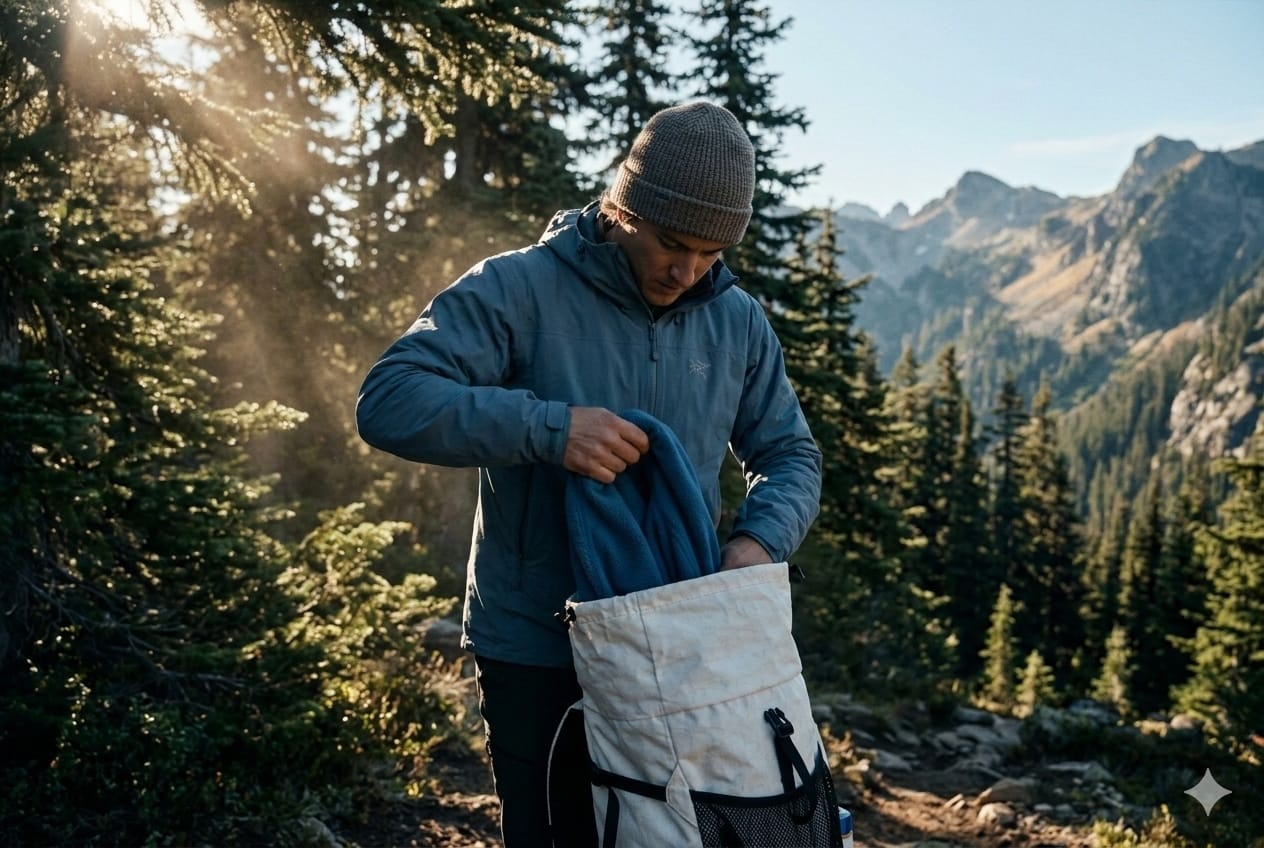
Every gram in your pack has a cost. You feel it at the trailhead when you hoist the thing, but the full reckoning arrives later: on the third climb of the day, on the descent where your knees are starting to object, at every break where you put the pack down and immediately feel about ten years younger. The bill shows up in your legs, your joints, and, least discussed of all, in your head.
Go lighter and two things change. You arrive less tired. And when the weather closes in, the light goes, or the ground turns technical, you think more clearly. Both are measurable. Both get worse, not better, as the day progresses.
Train hard. Fuel right. Pack smart. Go further.
The Hidden Cost: Energy, Tissue, and Judgement
Energy: The Metabolic Tax
Load carriage costs more energy than most people account for when they pack. Controlled treadmill work puts the increase at a few watts per extra kilogram at moderate walking speeds, with total energy cost rising substantially across the full range of loads tested [1]. Soft ground compounds it: sand costs between 2 and 2.7 times the energy of firm trail at the same pace [10].
On an eight-hour day, dropping 5 kg saves hundreds of kilocalories. Across a 60 to 100 day thru-hike that scales to tens of thousands of kilocalories your body never has to find from food or from muscle.
Drop 5 kg and you save hundreds of kilocalories a day: tens of thousands over a long trail.
That means less bonking late in the day, more margin when a big climb or a heat event arrives, and either slightly less food required for the same mileage or more ground covered on the same fuel. On a walk where you are probably already running a deficit, cutting the cost of every step is the single change that pays back hardest.
Joints, Spine, and Soft Tissue
Every extra kilogram also increases the mechanical work your joints absorb at each footfall. Ankle and knee loading tracks closely to linear with pack weight [1]. Military load-carriage reviews add more detail: heavier packs raise ground reaction forces through the knees, ankles, and hips, increase spinal loading and trunk-muscle demand, and produce the forward trunk lean that makes balance on rough terrain harder [2, 3].
Those stresses drive the injuries you know by name: patellofemoral pain, IT band syndrome, hip bursitis, lower-back inflammation. Fewer kilograms means less force per step. Run that across millions of steps and the difference in cumulative wear is real, not marginal.
The same forward lean also costs you balance. Heavier packs increase postural sway, shorten stride, and disrupt cadence [2]. More sway with more weight above your centre of gravity reduces the margin on talus, wet rock, and narrow trail. A lighter pack means a more upright posture, less side-to-side instability, and better balance when you are tired, which is exactly when stumbles happen.
Nerve Compression and Paresthesias
One of the few studies aimed at long-distance hikers specifically looked at pack weight against injury across a major trail. Among hikers carrying 4.5 to 9 kg, 35% reported paresthesias: numbness and tingling in hands or feet. At 9.5 to 13.5 kg, that rose to 50%. At 14 kg or more, it reached 68%. The heaviest category carried approximately 2.2 times the odds of nerve symptoms compared to the lightest [4].
Numb hands cannot grip. Numb feet cannot read the ground. On technical terrain, that costs you more than the extra water bottle ever gave you.
The Tired Brain: Load, Fatigue, and Decision-Making
Here is the cost that almost never comes up in gear-list discussions, and it is the one that matters most when things go sideways. Heavy packs do not just exhaust your muscles. They measurably degrade the cognitive functions you rely on when a decision has to be right.
In a controlled study, participants walked two hours under no load or a 40 kg load while performing attention and response tasks. Under load, false alarms climbed over time, response sensitivity fell, and reaction times slowed in the second hour. The loaded brain got progressively worse at distinguishing real signals from noise and quicker to respond incorrectly, and the deterioration tracked with fatigue [5].
Longer, more realistic protocols show the same pattern scaled up. Across three-hour marches at 21, 26, 33, and 43 kg, working-memory accuracy and inhibition both declined as load and time increased [6]. Separate work in realistic operational scenarios confirmed load and exertion erode cognitive control [7]. In one study where cognition appeared stable under heavy load, participants were burning extra mental effort to hold it there. That reserve is finite.
A heavier pack does not just tire your legs. It dulls the judgement you need most when the day turns.
Backcountry risk rarely arrives as a single hazard. It is tiredness, dehydration, and time pressure stacking up just before a steep descent, a swollen river crossing, or a route call in deteriorating visibility. Pack weight is one of the few inputs to that picture you can reduce before you leave the car park. Going lighter is a safety decision, not a comfort preference.
Fatigue and Recovery Between Days
Heavy loads also accelerate the onset of muscular and central nervous system fatigue within the day. Neuromuscular function takes 48 to 72 hours to recover fully after a hard load day [3]. Start each morning only partly recovered and compensatory patterns set in: gait changes, posture degrades, injury risk rises.
Carry less and you delay that onset, hold cleaner mechanics later into the day, and accumulate fewer unplanned zero days waiting for your body to reset. Over a long trail, the gap between hikers who sustain steady 20 to 30 km days and those constantly yo-yoing between big efforts and recovery often comes down to this.
The Long-Trail Effect: Why Months Change the Maths
A weekend trip does not expose the real cost of a heavy pack. Your body gets days between outings. Over 60 to 150 consecutive trail days, with no meaningful recovery between them, every mechanical and metabolic disadvantage compounds into something you cannot outpace.
A case study tracking a 112-day PCT hike measured a fall in vascular endothelial function and a rise in aortic stiffness over the walk, alongside minor unfavourable shifts in some body-composition subregions [9]. That is one hiker, not a cohort, but it shows how hard the sustained physiological load runs even before you factor in unnecessary pack weight. Each extra kilogram adds a small force increment per step. Run that through months and millions of repetitions and small becomes very large.
It shows up in the numbers that decide whether you finish. Heavier packs reduce daily kilometres, correlate with more pack-related injuries, and likely cut the probability of completing the trail [8]. Most thru-hikes have a seasonal window: beat the first snow, meet a permit date, do not run out of summer. The ability to add a few comfortable kilometres on an ordinary day, or to push when conditions demand it, can determine whether you finish at all.
It shows up in your body composition too. Thru-hikers commonly run a calorie deficit and lose body mass: one PCT hiker tracked over 128 days was in low energy availability throughout, losing 9% of body mass and 46% of fat mass [17]. Cutting the energy cost of walking helps from both sides: maintain the same mileage on slightly less food, which simplifies resupply and reduces food weight, or narrow the deficit on the same intake, protecting muscle and slowing loss. Lighter base weight and calorie-dense food are the same problem tackled from different ends.
From the Trail: What Hikers Actually Report
What long-distance hikers come back saying aligns closely with the physics. It also adds texture the data cannot.
The first thing they mention is that everything is simply easier. The day is easier, you reach camp with something left, and there is noticeably more spring in your step from the first hour to the last [11]. Getting back under the pack after a rest stops being an effort. Climbs feel less punishing. Descents do less damage. The end-of-day limp that follows an overpacked week starts to disappear.
The mileage follows. Chris Townsend made the observation plainly: the heavier the pack, the slower you walk uphill, the more often you need to stop, the sooner camp has to happen [15]. Trim several kilograms and the numbers shift: more distance in less time, more agility on technical ground [12]. A survey-based thesis on 2012 Appalachian Trail hikers found daily mileage fell as pack weight rose, and heavier packs drew more pack-related injury reports [8]. PCT and AT hikers who strip weight mid-trail consistently describe the same realisation. Days of 25 to 30 km stop feeling like achievements and start feeling like normal ones.
So do the overuse problems, in the other direction. Lighter loads come up repeatedly in hiker reports as the reason knee pain eased and IT band problems settled [13]. The mechanism is well established for the knee: peak and cumulative patellofemoral joint stress both rise with load carriage [18], and peak tibiofemoral joint forces increase directly with it [19]. Be aware the hiker injury data is less tidy than the biomechanics. The one study to test pack weight against injury across a long trail found a clear association with nerve symptoms, but not with joint sprains or chronic pain [4]. The forces are lower with a lighter pack; the injury benefit beyond nerve compression is reasonable inference rather than a settled finding.
Then there is the part that does not show up in any injury log. Perceived exertion tracks load closely: recreational hikers walking 8 km rated a 20% body-weight load as "fairly light" and a 40% load as "hard" [20]. Mood and motivation are harder to measure and I found no study testing them against pack weight, but hikers consistently report both improving as the load drops [14]. One PCT hiker described it directly: a lighter kit let them cover more ground with less strain and actually see the landscape rather than fixating on what their back and shoulders were doing [12]. After two or three months of that small daily difference, it accumulates into something significant. A pack that costs you something every morning is a drag that never fully clears.
Which is why the trajectory on most long trails is the same. Start heavy, mail things home, finish lighter and wishing you had started that way [16]. Survey data from 790 PCT hikers puts numbers on it: base weight fell about 10% between the start and end of the trail, and hikers who finished began roughly 3.5 lb lighter than those who did not [21]. When the pack is effectively attached to your body for months, you feel every ounce that has no business being there. The pressure to shed weight stops being philosophical around week three.
What to Aim For: Base-Weight Targets
Base weight is everything in the pack excluding consumables (food, water, fuel). Total pack weight varies daily; base weight is the number you actually control.
| Pack Category | Base Weight | Suited To |
|---|---|---|
| Traditional | 14 to 18 kg+ | Car camping, casual day trips |
| Lightweight | 7 to 9 kg | Multi-day and weekend trips |
| Ultralight | 4.5 kg or under | Thru-hiking, experienced hikers |
| Super-Ultralight | Under 2.5 kg | Expert only, minimal margin |
Most experienced hikers settle somewhere in the "light but not stupid" range: 4.5 to 7 kg base. That is a real reduction from legacy gear while keeping sufficient warmth, shelter integrity, and safety redundancy.
The right target is route-specific, not something you can transfer from someone else's kit list. A 5 kg base that is adequate on a marked summer trail can be dangerously thin on a remote winter traverse. Set the target against the conditions.
Train Hard: Preparing for the Load You Do Carry
A lighter pack is not a substitute for being prepared to carry it. Both matter.
Train With Load, and on the Ground You Will Walk
The standard mistake: months of packless training, then first day on trail under full weight. Your body needs time to adapt to the spinal loading, the shifted centre of mass, and the changed muscular demands. Start well below target trail weight and build progressively, aiming to reach close to pack weight in the final weeks. Include back-to-back long days. Fatigue-driven compensations show up on day two, not day one, and that is when you want to find them.
Terrain matters as much as load. Treadmill kilometres condition the engine. They do not replicate the proprioceptive demands of real uneven ground under weight. Get time on comparable terrain before you go. That is also where you find the pack's pressure points, the footwear that does not survive, and whatever else needs sorting before it becomes a problem on trail.
For a multi-month hike, structure the build over months: consistent weekly distance over 8 to 12 weeks, load introduced progressively over the next 8, full-weight back-to-back days in the final 4 to 6. Arrive at the trailhead adapted. Not just aerobically fit: adapted.
Build the Right Muscle Groups
Load carriage hits the posterior chain hard: glutes, hamstrings, erector spinae. Add hip abductors, calves, and the deep core stabilisers. Romanian deadlifts, single-leg squats, hip thrusts, loaded step-ups, and anti-rotation core work build the foundation that keeps your gait honest when you are tired and loaded. Feet and ankles deserve specific attention. A disproportionate share of trail injuries land there, and the risk rises with load and fatigue. Calf raises, single-leg balance work, and foot strengthening are worth the time.
Light but Not Stupid: Weight Against Risk
Cutting weight is not consequence-free. Every gram you take out has to justify itself against what it provided, and some things provide protection that no speed or energy saving replaces.
Some weight is non-negotiable. Emergency shelter capable of handling the worst conditions your route can produce. Not the typical conditions: the worst. Insulation matched to the worst-case temperature, not the forecast. Navigation tools. A first aid kit scaled to your remoteness. Water treatment. That weight earns its place regardless of the scales. The ultralight saying holds: there is no comfortable emergency if you left the gear for it at home.
What counts as non-negotiable depends on where you are going. A Sierra high route in August and an alpine traverse in unsettled weather have almost nothing in common in risk terms. Research the remoteness from rescue, the weather variability, the water situation, and the technical sections, and let that picture set your minimum kit. When uncertain, carry the margin.
It also depends on who you are. A 5 kg base weight that actually works was built over years of iteration on real terrain, not assembled off someone else's spreadsheet. That hiker knows exactly which items they reach for and which have never been opened. That knowledge is earned through trips, not purchased. If you are still building it, run a fuller kit, watch what you use, and reduce methodically across outings. Going light safely is a process.
For anything you are considering cutting, apply the redundancy test: if it fails or is lost, what actually happens? If the honest answer involves genuine risk to safety, it stays. If the answer is inconvenience, it is a candidate. Redundancy costs weight, and its value only shows up in the moments you need it.
The Bottom Line
The physics and the trail reports say the same thing. A lighter pack reduces joint load, lowers injury risk, costs less energy per kilometre, and keeps you thinking clearly when the day gets hard.
Carry exactly what you need. No more.
Train hard. Fuel right. Pack smart. Go further.
Back in Pack.
References
- Bastien GJ, Willems PA, Schepens B, Heglund NC. Effect of load and speed on the energetic cost of human walking. European Journal of Applied Physiology. 2005;94(1-2):76-83. doi:10.1007/s00421-004-1286-z
- Fox BD, Judge LW, Dickin DC, Wang H. Biomechanics of Military Load Carriage and Resulting Musculoskeletal Injury: A Review. Journal of Orthopedics and Orthopedic Surgery. 2020;1(1):6-11. doi:10.29245/2767-5130/2020/1.1104
- Knapik JJ, Reynolds KL, Harman E. Soldier load carriage: historical, physiological, biomechanical, and medical aspects. Military Medicine. 2004;169(1):45-56. doi:10.7205/milmed.169.1.45
- Anderson LS Jr, Rebholz CM, White LF, Mitchell P, Curcio EP 3rd, Feldman JA, Kahn JH. The Impact of Footwear and Packweight on Injury and Illness Among Long-Distance Hikers. Wilderness & Environmental Medicine. 2009;20(3):250-256. pubmed.ncbi.nlm.nih.gov/19737037/
- Eddy MD, Hasselquist L, Giles G, et al. The Effects of Load Carriage and Physical Fatigue on Cognitive Performance. PLoS ONE. 2015;10(7):e0130817. pmc.ncbi.nlm.nih.gov/articles/PMC4496096/
- Armstrong N, Smith S, Risius D, et al. Cognitive performance of military men and women during prolonged load carriage. BMJ Military Health. 2022. pubmed.ncbi.nlm.nih.gov/35393357/
- Giles GE, Hasselquist L, Caruso C, Eddy MD. Load Carriage and Physical Exertion Influence Cognitive Control in Military Scenarios. Medicine & Science in Sports & Exercise. 2019;51:2540-2546.
- Thomas AT. Effects of Pack Weight on Endurance of Long-distance Hikers. MSc thesis, Embry-Riddle Aeronautical University, Spring 2013. commons.erau.edu/edt/140/
- Heinbockel TC, Craighead DH. Case studies in physiology: Impact of a long-distance hike on the Pacific Crest Trail on arterial function and body composition in a highly fit young male. Physiological Reports. 2021;9(5):e14767. doi:10.14814/phy2.14767
- Lejeune TM, Willems PA, Heglund NC. Mechanics and energetics of human locomotion on sand. Journal of Experimental Biology. 1998;201(13):2071-2080.
- Slower Hiking. Seven Reasons to Reduce Your Pack Weight. slowerhiking.com
- Hammock Gear. The Truth About Ultralight Backpacking: Benefits and Drawbacks. hammockgear.com
- Light Hiking Gear. How Ultralight Hiking Helps Prevent Injury Over Time. lighthikinggear.com
- Igneous Gear. The Health Benefits of Ultralight Backpacking. igneousgear.com
- Townsend C. Ultralight Backpacking: Some Thoughts. christownsendoutdoors.com
- Alice Hikes. PCT Gear Lists: Start vs Finish. alicehikes.com
- Weiss EP, Frech AM, Perez VR. Low Energy Availability and Increased Risk of Relative Energy Deficiency in Sport (RED-S) During a 3767-km Thru-Hike on the Pacific Crest Trail: A Case Study. Wilderness & Environmental Medicine. 2023;34(4):536-542. doi:10.1016/j.wem.2023.06.011
- Willy RW, Simon JE, Hanser B, et al. Females Exhibit Greater Peak and Cumulative Patellofemoral Joint Stress With Moderate and Heavy Load Carriage Compared With Males. European Journal of Sport Science. 2025;25(9):e70046. doi:10.1002/ejsc.70046
- Jones BW, Willson JD, DeVita P, Wedge RD. Opposite Medial and Lateral Tibiofemoral Joint Compartment Responses Between Dominant and Nondominant Limbs When Walking With Load Carriage. Journal of Applied Biomechanics. 2026;42(1):16-21. doi:10.1123/jab.2024-0294
- Simpson KM, Munro BJ, Steele JR. Effect of load mass on posture, heart rate and subjective responses of recreational female hikers to prolonged load carriage. Applied Ergonomics. 2011;42(3):403-410. doi:10.1016/j.apergo.2010.08.018
- Halfway Anywhere. Data-Driven Pacific Crest Trail Gear Guide for 2026 (n=790 hiker survey). halfwayanywhere.com