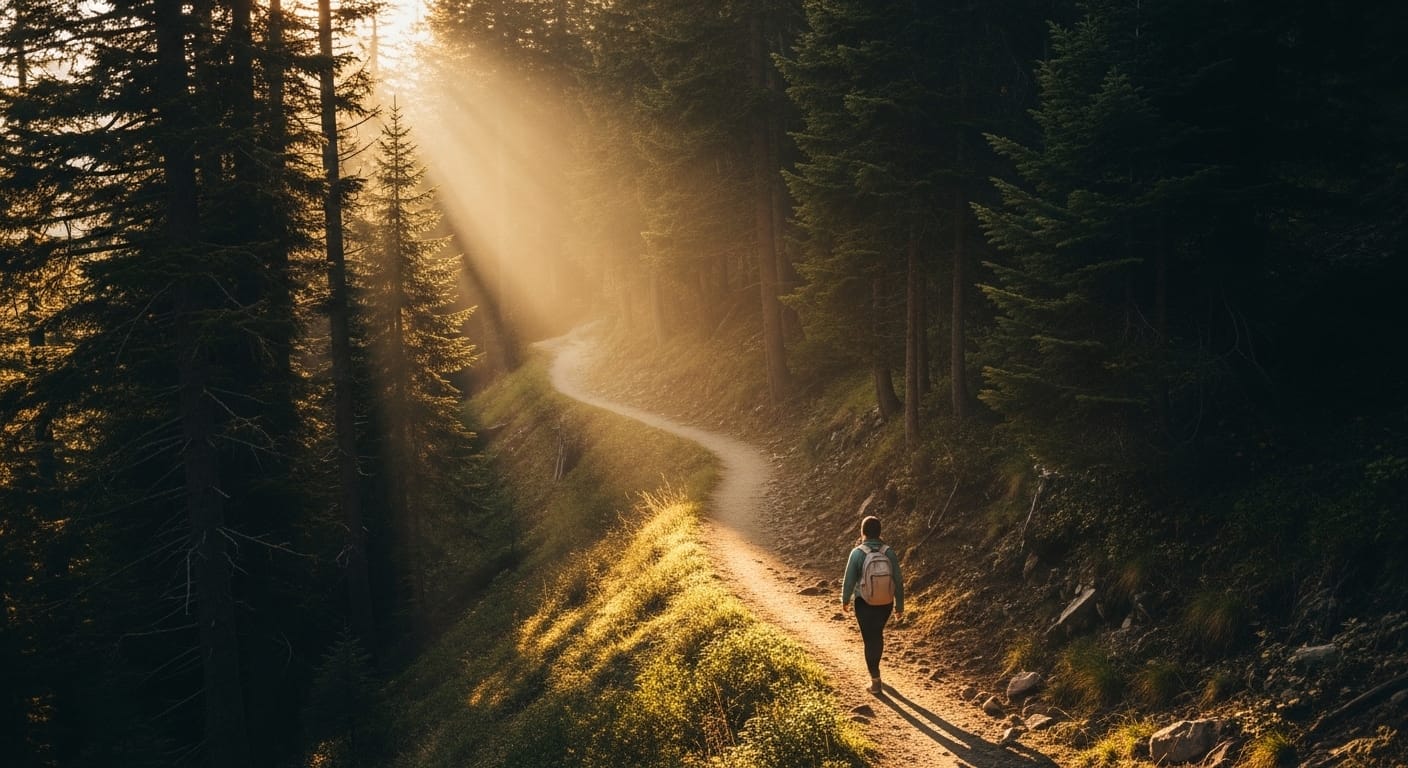
Picture two hikers leaving the trailhead at 7am. Hiker A moves fast: head down, poles pumping, chewing up ground. Hiker B moves at a pace that feels almost too easy, like a brisk Sunday stroll. By noon, Hiker A is cooked, digging into emergency snacks to fight off heavy legs. Hiker B is still moving steadily, eating lunch at the top, thinking about tomorrow's miles.
Hiker B isn't fitter. She just knows something Hiker A is about to learn the hard way.
When you're new to hiking, speed looks like ambition. It feels productive. But on a long trail, especially over multiple days, pace matters more than almost anything else. The hikers who consistently cover the most ground, come home healthy, and actually enjoy themselves are rarely the fastest ones out of the car park. They've learned how to go slow.
Here's why that works, and what it looks like in practice.
What Your Body Is Actually Running On
Your muscles need energy to move. Your body has two main ways to produce it, and which one it leans on depends almost entirely on how hard you're pushing.
At a comfortable, conversational pace, your body runs primarily on aerobic metabolism, a process that uses oxygen to burn fat for fuel. This is the engine you want on a long hike. Fat stores are enormous compared to carbohydrate reserves; even a lean person carries enough fat energy to fuel many hours of easy movement.
Push above that comfortable pace, where breathing gets harder and legs start burning, and your body shifts toward glycolytic metabolism, which burns through carbohydrates (glycogen). Glycogen is limited. A well-fuelled hiker might carry enough for a few hours of hard effort. Once those stores drop, you feel it: heavy legs, fuzzy thinking, a desperate need to stop.
On a 6–8 hour day, you simply cannot sustain glycogen-burning intensity the whole way. You'll be managing a fuel crisis by mid-afternoon while the slower hiker is still cruising.
Staying at a pace where you can hold a full conversation keeps you in what endurance coaches call Zone 2: the fat-burning zone you can sustain for hours [1]. The underlying physiology is the crossover concept: below roughly 45% of maximal oxygen uptake a trained person runs mainly on fat, and carbohydrate takes over as intensity climbs [8]. Your energy stays consistent. You arrive at camp tired but not destroyed.
The talk test: If you can speak in full sentences while hiking without gasping, you're at roughly the right pace. If you're too breathless to talk, slow down. No app required.
The Injury Pattern Nobody Warns You About
The frustrating thing about overuse injuries is they don't announce themselves immediately. You push hard on day one, feel fine at camp, push hard again on day two, and on day three your knee starts to bark. By day four you're limping.
That's the pattern, and it catches beginners more than anyone.
Every step on trail sends a force up through your foot, ankle, knee, and hip. The faster you move, especially on descents, the greater that impact. When you're new to hiking, your muscles and connective tissue haven't yet adapted to the repetitive demands of multi-day movement. Tendons and cartilage need weeks and months of progressive loading to strengthen. Enthusiasm alone won't speed that up.
The most common overuse injuries in beginner hikers [2]:
- Hiker's knee (patellofemoral pain): pain behind or around the kneecap, usually from descending too fast
- IT band syndrome: sharp pain on the outside of the knee, caused by repeated knee flexion, often triggered when hip muscles fatigue and lose control of leg rotation
- Plantar fasciitis: heel and arch pain from high cumulative impact on the foot
IT band syndrome is worth calling out specifically because it's so common and so preventable. It tends to develop when hikers push big mileage before their hip muscles are strong enough to keep the leg tracking properly [3]. Build gradually and the IT band usually stays quiet.
Gradual progression matters. Your cardiovascular fitness adapts quickly, within days. Your connective tissue takes much longer. Moving at a pace that respects that lag is how you stay on trail.
Trekking poles are worth mentioning here too. Research on downhill walking shows that using poles reduces the load going through knee joints on descents [4]. For beginners on longer trips, that's a meaningful injury buffer, especially in the latter hours of a big day when form starts to break down.
The Counterintuitive Mileage Fact
This one feels backwards until you've experienced it.
A hiker who covers 20km fast, burning through glycogen and hammering joints, arrives at camp wrecked. She sleeps badly: exhausted muscles don't always produce good sleep, especially when something hurts. Day two starts stiff. She's slower. By day three, something hurts enough to change the plan.
A hiker who covers the same 20km at a sustainable pace arrives tired but functional. She eats, sleeps well, wakes up stiff but not damaged, and is moving well within the first hour. Over a five-day trip, that difference compounds.
Long-distance hikers worked this out early. On the Appalachian Trail and Pacific Crest Trail, the people who consistently hit their targets aren't racing between stops. They move steadily, take short breaks, and finish the day with something left [5]. That is trail lore rather than research, but the underlying principle has been tested at scale elsewhere: across 13,829 finishers of the Ultra-Trail du Mont Blanc, even pacing was associated with faster finishing times regardless of age or sex [9]. The slow hiker isn't saving energy. She's investing it in tomorrow.
Tired Bodies Make Bad Decisions
Physical fatigue and cognitive function are connected more tightly than most people realise.
When you're depleted from pushing too hard, through low glycogen, accumulated muscle fatigue or dehydration, your judgement degrades. Route choices that should be obvious get murky. You push past your turnaround time because stopping feels like failure. You attempt a river crossing you'd decline with fresh legs.
This isn't speculation, though the evidence is narrower than the claim usually made for it. Testing soldiers walking under load, researchers found that fatigue combined with pack weight increased false alarms and degraded sustained attention and response inhibition [7]. Those are the building blocks of judgement rather than judgement itself; the leap from a lab task to a river-crossing decision is mine, not the researchers'. The same dynamic plays out on trail, especially in unfamiliar terrain.
For beginners, that matters more than for experienced hikers. You're still building your trail literacy, learning to read weather changes, terrain hazards, your own body signals. That skill development requires mental bandwidth you can't access if you've burned through your reserves trying to keep up with a faster group.
Slow hiking keeps your brain available when you need it.
You Notice Where You Are
This sounds obvious said out loud, but it gets lost in the pressure to cover kilometres.
When you're not gasping and grinding, you look up. You notice the light coming through the trees at 7am. You hear the bird you can't name but will look up later. You stop at the viewpoint because you have time, not because you're already behind.
Many beginner hikers who quit the sport early report the same thing: it became a slog. The thing that got them outside, being in a beautiful place and doing something good for their body, got buried under mileage pressure.
There's solid research on hiking and mental health, with studies consistently showing reductions in anxiety, stress, and ruminative thinking from time in natural environments [6]. That benefit is tied to actually being present. A pace that keeps you inside your own head, counting steps, doesn't deliver the same return.
What This Looks Like in Practice
Start at a pace that feels slightly too easy. On an 8-hour day, the first hour should feel almost comfortable. You'll warm into it. If you're breathing hard in the first 30 minutes, you've started too fast.
Use the talk test. Full sentences without gasping = right zone. Too breathless to speak = too fast. This is the most reliable way to gauge effort without any technology.
Plan for time, not just distance. "25km" tells you very little. "25km with 1,200m of elevation gain over 9 hours" tells you what you're actually dealing with. Plan your day around your realistic fitness and build in margin, especially early in a trip.
Short breaks beat long stops. Sitting down for 20 minutes lets muscles stiffen. Five minutes standing, eating, drinking, then moving again keeps you looser and psychologically in the rhythm.
Walk through general tiredness; stop for pain. The heavy legs and mild ache of a long day are normal. That's adaptation happening. Sharp or localised pain in a joint is a different signal: stop and assess before it becomes a problem.
Build week on week. If you're new to multi-day hiking, start shorter and work up. Two consecutive 15km days will teach your body more about recovering and moving the next morning than one ambitious 30km day that leaves you unable to walk properly on day two.
On Keeping Up With Faster Hikers
One of the most common traps for beginners is trying to match a faster hiker's pace. Maybe it's a friend who's done this before, a partner with longer legs, or just the social discomfort of being the one at the back.
Hiking at someone else's pace when it's above your sustainable level isn't humility. It's a fast track to injury. A good hiking partner will always prefer slowing down to carrying you out.
Being at the back of the group isn't a fitness failure. It's your body telling you it needs more progressive loading before it can match that output. The answer is to keep hiking, build your distances gradually, and let your aerobic base and connective tissue catch up, not to push through someone else's pace until something breaks.
The Bottom Line
Speed looks good in a trip report. Sustainability wins on trail.
A conversational pace keeps your energy systems running efficiently, reduces injury risk, keeps your judgement sharp, and builds the trail fitness that compounds over weeks instead of burning out after three days. For beginners, learning to go slow is the most useful habit you can build.
You won't hike slowly forever. As your aerobic base builds and your body adapts to the demands of the trail, your sustainable pace will naturally lift. The miles that feel hard now will feel easier. The pace that felt like holding back will become your default.
But that only happens if you give your body time to adapt instead of hammering it every outing.
Go at your own pace. Then see how far you actually go.
Train hard. Fuel right. Pack smart. Go further.
References
- Rutberg J. Zone 2 Training to Improve Aerobic Endurance and Fat Burning. Carmichael Training Systems. Updated March 2025. trainright.com (coaching guidance, not primary research)
- American Academy of Orthopaedic Surgeons. Patellofemoral Pain Syndrome. OrthoInfo. orthoinfo.aaos.org
- American Academy of Orthopaedic Surgeons. Iliotibial Band (IT Band) Syndrome. OrthoInfo. orthoinfo.aaos.org See also Plantar Fasciitis and Bone Spurs. orthoinfo.aaos.org
- Bohne M, Abendroth-Smith J. Effects of hiking downhill using trekking poles while carrying external loads. Medicine & Science in Sports & Exercise. 2007. PMID 17218900
- The Hike Tribe. Pacing Yourself on a Hike: How to Manage Energy and Avoid Burnout. thehikingtribe.com (hiker community guidance, not primary research)
- Bratman GN, et al. Nature and mental health: An ecosystem services perspective. Science Advances. 2019. doi:10.1126/sciadv.aax0903
- Eddy MD, Hasselquist L, Giles G, et al. The Effects of Load Carriage and Physical Fatigue on Cognitive Performance. PLoS ONE. 2015;10(7):e0130817. PMC4496096
- Brooks GA, Mercier J. Balance of carbohydrate and lipid utilization during exercise: the "crossover" concept. Journal of Applied Physiology. 1994;76(6):2253-2261. doi:10.1152/jappl.1994.76.6.2253
- Suter D, Sousa CV, Hill L, Scheer V, Nikolaidis PT, Knechtle B. Even Pacing Is Associated with Faster Finishing Times in Ultramarathon Distance Trail Running - The "Ultra-Trail du Mont Blanc" 2008-2019. International Journal of Environmental Research and Public Health. 2020;17(19):7074. doi:10.3390/ijerph17197074