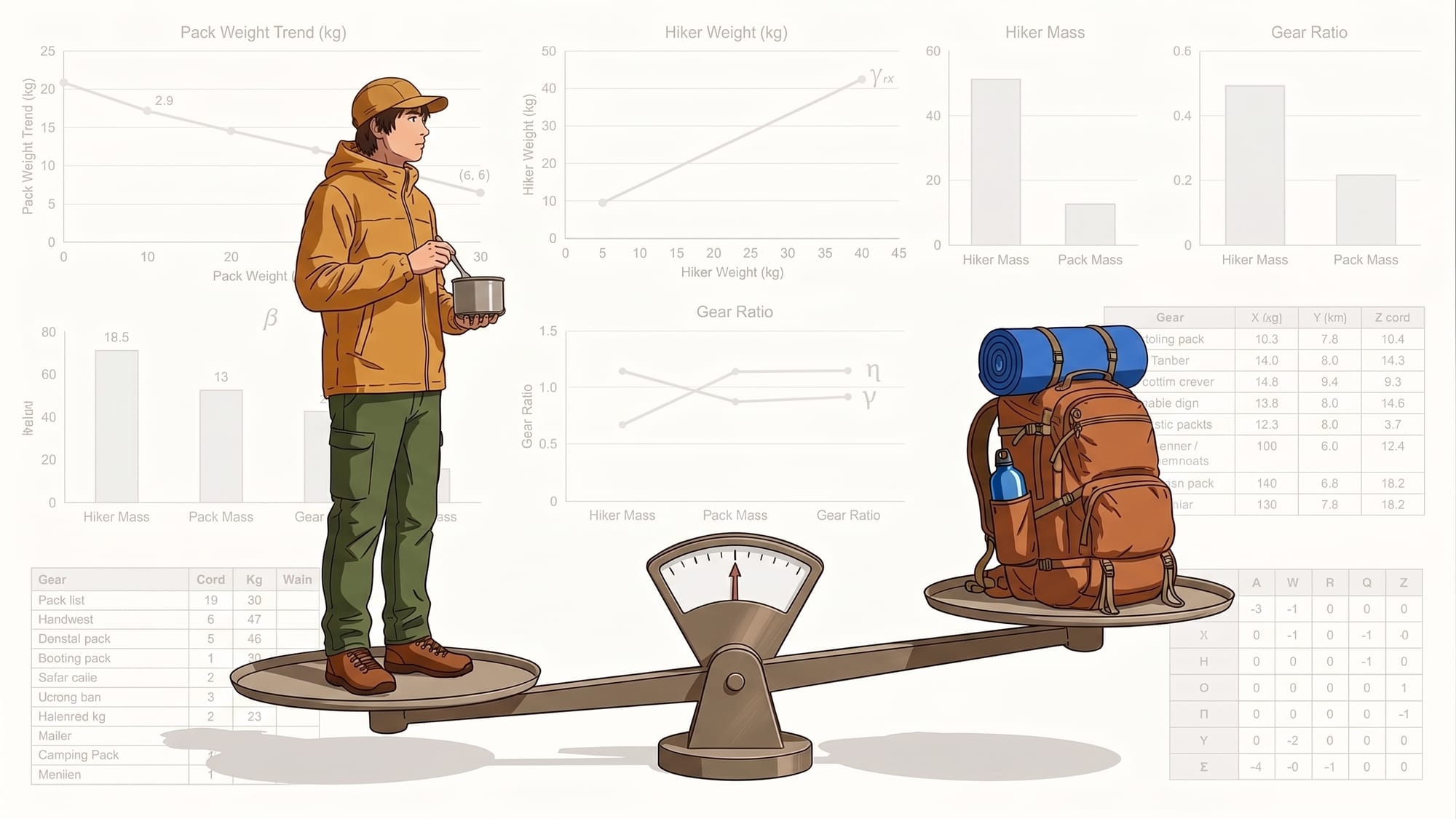
You've probably heard the 20% rule. Don't carry more than 20% of your body weight. It gets cited in gear guides, repeated by beginners, and occasionally appears in retailer FAQs. The problem: the rule traces back to 1950s US military studies conducted on trained 20-year-old soldiers. Even the military's own recommendations said no soldier should carry more than 17% of body weight for any extended period. The 20% figure doesn't describe an ideal. It describes what fit young soldiers could manage under operational pressure.
For recreational hikers across a range of ages, fitness levels, and body compositions, 20% is often too much. And for lighter hikers, it's too conservative in the other direction.
The more useful framing (and the one with biomechanical backing) is to work out where your load-to-bodyweight ratio sits on the effort-and-injury curve, then train for it.
Where the 20% Rule Came From
The 20% figure became hiking gospel because it was simple, memorable, and attached to credible-sounding institutional origins. But military load carriage standards were never designed for recreational hikers. They were built around short-duration high-intensity missions, carried out by fit young men conditioned specifically for load carriage.
In 2001, an Army Science Board study recommended no soldier carry more than 50 pounds (22.7 kg) for any sustained period, a recommendation widely ignored in the field. The injury data tells the rest of the story: heavy loads over consecutive days drive knee, ankle, back, and nerve injuries at high rates. A review of military load carriage literature found 45% of combat forces reported a musculoskeletal injury over a 12-month deployment, with load-bearing activities a primary driver [1].
That's the baseline the 20% rule comes from. It was never about optimal performance. It was about not breaking people.
The Physics of Body Size and Carrying Capacity
In 2014, Kansas State University physics professor Michael O'Shea published a model in The Physics Teacher that explained something experienced trail leaders had noticed for years: smaller hikers often carry proportionally heavier loads with more ease than larger hikers of similar fitness [2].
The reason comes down to how strength scales with body size. As a person gets bigger, strength increases more slowly than body weight. The same principle that lets ants carry many times their own mass while larger animals cannot applies to human hikers, in a much more modest way.
O'Shea's model shows that effective carrying capacity is a curve running in the opposite direction from what the 20% rule implies. The table below uses values reported in his paper and by outlets that covered his research:
| Body weight | Maximum comfortable pack weight | Pack as % of body weight |
|---|---|---|
| 51 kg (112 lb) | ~22.7 kg (50 lb) | ~44% |
| 79 kg (175 lb) | ~19 kg (42 lb) | ~24% |
| 109 kg (240 lb) | ~15 kg (34 lb) | ~14% |
O'Shea (2014), The Physics Teacher. Assumes comparable body composition and fitness levels.
The implication: a 55 kg hiker can carry considerably more relative to body weight than a 90 kg hiker. The 20% rule disadvantages lighter hikers and sets an unrealistically permissive ceiling for heavier ones.
O'Shea's model assumes comparable body composition: it compares people of similar fitness, where an increase in size corresponds to a proportional increase in strength. It doesn't account for injury history, trip length, or training background. But it's a more accurate starting point than a fixed percentage borrowed from military manuals.
What the Biomechanics Actually Show
There's a growing body of research specifically on recreational hikers, and the pattern is consistent: loads beyond 10% of body weight produce measurable, progressive changes in walking mechanics, and those changes compound over distance.
A 2026 study of Camino de Santiago hikers, assessed after completing stages of 20+ km, found clear load-dependent increases in plantar pressure at both 10% and 20% body weight loads compared with an unloaded baseline [3]:
- Static forefoot pressure rose 5.4% at 10% body weight and 8.7% at 20% body weight
- Rearfoot pressure increased 5.0% at 10% and 10.2% at 20%
- Total foot pressure climbed 5.0% at 10% and 9.6% at 20%
These aren't catastrophic numbers on a single day. Multiply them across 20 km, across consecutive days, across a two-week route, and the mechanical load adds up to real wear on joints, fascia, and connective tissue.
Earlier controlled research on recreational female hikers carrying loads from 0–40% of body weight found ground reaction forces increased proportionally with load, with stance time lengthening and mediolateral impulse rising sharply at 30% and 40% body weight [4]. A separate study of lower limb muscle activity found altered activation patterns under backpack loads significant enough that the authors recommended a 30% body weight limit to reduce lower limb injury risk, noting explicitly that lower was better [5].
The paresthesia data is particularly direct. A study of long-distance hikers found that 35% of those carrying 4.5–9 kg packs reported numbness or tingling, rising to 50% at 9.5–13.5 kg and 68% at packs over 14 kg. The heaviest group carried approximately 2.2 times the odds of nerve symptoms compared with the lightest [6].
Load Tiers and What Each One Demands
A single rule doesn't serve hikers across the full range of pack weights. The tiers below reflect the relative physiological demands of each load bracket. Your actual threshold depends on body weight, fitness level, and how many consecutive days you're carrying the load.
| % of body weight | Load category | Physiological demand |
|---|---|---|
| 0–15% | Lightweight | Aerobic capacity is the primary limiter; joint stress is low |
| 16–25% | Moderate | Muscular endurance becomes a factor; shoulder and back loading increases |
| 26–35% | Heavy | Compound strength and spinal stability needed; injury risk rises sharply |
| 36%+ | Expedition | Requires structured conditioning; cumulative damage risk is high without preparation |
0–15%: Lightweight
At this range, pack weight isn't significantly altering your biomechanics. Your aerobic base and leg endurance are doing the work. The risk isn't injury from load. It's underprepared legs on steep terrain or long mileage days.
Training focus: Aerobic base (running, cycling, hiking with elevation gain), lower body strength (weighted lunges, step-ups, single-leg squats), and core stability. Core work matters more than most people account for: a stable trunk under even a light pack reduces lower back fatigue across long days. Hip flexor and calf mobility prevent the most common soft tissue niggles at this load level.
16–25%: Moderate
This is traditional backpacking territory. Your shoulders are feeling the harness by day two, and the spine is accumulating compressive load across each consecutive day. The forward lean the pack creates shifts demand through your posterior chain.
Training focus: Shift from pure aerobic work toward muscular endurance: longer runs, day hikes with vertical. Add loaded lower body work: goblet squats, Romanian deadlifts, weighted step-ups. The harness demands shoulder and upper back strength: dumbbell rows, lat pulldowns, face pulls. Chest openers and thoracic spine mobility offset the forward-roll posture the pack encourages.
26–35%: Heavy
Winter kits, packrafting setups, trip leaders carrying group gear: this range requires direct preparation. The joint forces at this load level are high enough that untrained hikers hit trouble within the first two or three days.
Training focus: Weighted carries need to be in your programme: farmer's walks, Zercher carries, rucking sessions on real terrain. Heavy compound lifts (deadlifts, back squats) build the posterior chain your spine relies on. Ankle stability work matters: stabilising muscles work considerably harder to manage the shifted centre of mass on uneven ground. Build training load progressively over six to eight weeks before the trip.
36%+: Expedition
Multi-week unsupported routes, mountaineering carries, hunting trips with heavy food and fuel loads. This tier shouldn't be entered without prior time at the 26–35% bracket.
Training focus: Rucking (extended sessions with a loaded pack on real terrain) needs to be the foundation of your preparation. Volume and frequency matter as much as intensity. Full-body functional conditioning: sled pushes, sandbag carries, overhead work. Recovery management is as important as training load. At this tier the margin between productive training and accumulated injury is narrow. Track sleep, monitor soreness, and back off when the signals appear.
Adjusting for Body Weight: A Working Guide
Given O'Shea's findings, lighter hikers can apply a more generous ceiling than heavier hikers. As a working starting point before training-specific adjustments:
- Under 60 kg: 20–25% is physiologically manageable if you're fit and conditioned
- 60–80 kg: 15–20% is a sensible target for multi-day routes; above 20% requires direct preparation
- Over 80 kg: aim for 12–15% on extended routes; above 20% demands specific strength conditioning
Fitness and conditioning shift these figures in your favour. But as a baseline, they give you a more honest starting point than a flat 20%.
The Cumulative Damage Argument
Weekend trips give the body recovery time between load sessions. Multi-day and multi-week routes don't. Load stress becomes a chronic exposure problem: every extra kilogram adds force per step, and over millions of steps on a long route, that compounds into real wear on knees, ankles, hips, and the lower back.
Research on long-distance trail hikers found that heavier packs were associated with more pack-related injuries, fewer miles covered per day, and higher rates of abandoning the route [7]. The mechanism is straightforward: higher mechanical load drives faster tissue fatigue, which forces compensated gait patterns, which drives overuse injuries.
Every kilogram you can remove from your pack, without cutting safety margins for weather, navigation, and emergency shelter, pays back in reduced injury risk and better performance across long days and long routes.
For a practical guide to identifying and cutting those kilograms, see Pack Light. Go Further.
Train hard. Fuel right. Pack smart. Go further.
References
- Knapik JJ, Reynolds KL, Harman E. Soldier load carriage: historical, physiological, biomechanical, and medical aspects. Military Medicine. 2004;169(1):45-56. doi:10.7205/milmed.169.1.45
- O'Shea M. Backpack Weight and the Scaling of the Human Frame. The Physics Teacher. 2014;52(8):479–481. doi:10.1119/1.4897584
- Moya-Cuenca C, Zúnica-García S, Gracia-Sánchez A, et al. Plantar Pressure Responses to Backpack Load in Long-Distance Hikers: A Cross-Sectional Observational Study. Journal of Functional Morphology and Kinesiology. 2026;11(1):36. PMC12821408
- Simpson KM, Munro BJ, Steele JR. Effects of prolonged load carriage on ground reaction forces, lower limb kinematics and spatio-temporal parameters in female recreational hikers. Ergonomics. 2012;55(3). PMID 22409169
- Simpson KM, Munro BJ, Steele JR. Backpack load affects lower limb muscle activity patterns of female hikers during prolonged load carriage. Journal of Electromyography and Kinesiology. 2011. PMID 21705231
- Anderson LS Jr, Rebholz CM, White LF, Mitchell P, Curcio EP 3rd, Feldman JA, Kahn JH. The Impact of Footwear and Packweight on Injury and Illness Among Long-Distance Hikers. Wilderness & Environmental Medicine. 2009;20(3):250–256. PMID 19737037
- Thomas AT. Effects of Pack Weight on Endurance of Long-distance Hikers. MSc thesis, Embry-Riddle Aeronautical University, Spring 2013. commons.erau.edu/edt/140/